

Plastic vs. Tyvek Wristbands: How to Decide Which Material Fits Your Event
Plastic and Tyvek are the two most popular event wristband materials, and choosing between them comes down to how long your event runs, how much security you need, and what your budget allows. Both prevent unauthorized sharing through tamper-evident closures, and both support custom printing with logos, text, and barcodes. The difference is in durability, water resistance, and cost. Picking the wrong one means either overpaying for features a one-day event does not need or using a band that breaks down halfway through a weekend festival. Here is a direct comparison across every factor that matters.
Side-by-Side: How the Two Materials Compare
Before diving into the details, a quick comparison table shows where each material wins and where it falls short.
| Factor | Tyvek | Plastic |
|---|---|---|
| Wear duration | 1-2 days | 3-7 days |
| Closure type | Adhesive strip with security die-cuts | One-time locking snap |
| Waterproof | Water-resistant (handles rain, not submersion) | Fully waterproof |
| Customization | Print, barcodes, sequential numbering, full color | Print, barcodes, holographic |
| Custom production time | 1 business day | ~7 business days |
| Price tier | Lowest per-unit cost | Mid-range |
| Best for | Single-day events on a budget | Multi-day events needing waterproof security |
Both materials prevent wristband transfer through their respective closures, but the mechanisms work differently and hold up over different timeframes.
Durability and Wear Time
The single biggest difference between plastic and Tyvek is how long each band lasts on a wrist. That difference should be the first filter in your decision.
How Long Do Tyvek Wristbands Last
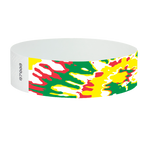
Tyvek wristbands are designed for one to two days of continuous wear. The DuPont Tyvek material is tear-resistant and water-resistant, holding up through a full day at a concert, fair, or school event without falling apart. After 48 hours, the adhesive closure can start to weaken from moisture and friction, so Tyvek is not recommended for multi-day use.
How Long Do Plastic Wristbands Last
Plastic wristbands are built for three to seven days. The tri-laminate construction (layers of polyethylene and polyester) makes the band fully waterproof, stretch-resistant, and tear-resistant. The locking snap closure maintains its hold throughout, so the band stays just as secure on day seven as it was on day one.
- Choose Tyvek for any event that wraps in a single day.
- Choose plastic for events running two days or longer.
- For events lasting more than a week, consider vinyl wristbands, which hold up for up to 14 days.
Security: Which Closure Is More Secure?
Both closures are tamper-evident, meaning removal damages the band and prevents reuse. The question is which mechanism provides stronger security for your event's timeline.
Tyvek's Adhesive Closure
The adhesive strip on a Tyvek band bonds to itself once wrapped and pressed. Security die-cuts weaken the material at the closure point, so any attempt to peel the band off tears it visibly. For a single-day event, this level of security is more than sufficient. Guests cannot remove and share the band without destroying it.
Plastic's Locking Snap
The plastic snap pushes through a barrel and catches on an internal ridge, locking in one direction only. Reopening the closure by hand is not possible. Removal requires cutting the band with scissors. For multi-day events where bands face repeated stress from water, sweat, and physical activity, the mechanical lock holds up better than an adhesive bond over time. Multiple notch positions along the band allow the closure to adjust to any wrist size, from a child to a large adult, without excess slack that could catch on objects.
Key differences between the two closures:
- Tyvek adhesive seals once, tears on removal, and is ideal for events lasting one to two days.
- Plastic snaps lock mechanically, must be cut off, and maintain full security for three to seven days.
- Both closures are tamper-evident, but only the snap resists degradation from prolonged water and sweat exposure.
Which Is More Secure Overall?
On day one, both closures are equally tamper-evident. Over multiple days, the snap closure on plastic bands maintains its integrity longer because it does not rely on an adhesive bond that can weaken with moisture exposure. If your event runs more than two days and security is a priority, plastic is the safer choice.
Water Resistance
Events near water, whether pools, lakes, waterparks, or outdoor venues during rainy season, need a band that survives getting wet.
Tyvek in Wet Conditions
Tyvek is water-resistant, not waterproof. Rain, splashes, and sweat will not destroy the band, but prolonged submersion can soften the adhesive closure and compromise the seal. For a rainy outdoor concert, Tyvek holds up fine. For a waterpark, it does not.
Plastic in Wet Conditions
Plastic is fully waterproof. The tri-laminate material and snap closure are unaffected by submersion, making plastic the correct choice for waterparks, pool events, and any situation where the band will be soaked repeatedly.
Cost and Production Time
Budget and timeline often make the final decision when both materials could technically work.
Tyvek Pricing and Speed
Tyvek has the lowest per-unit cost of any wristband material. Custom Tyvek orders ship in one business day, and stock Tyvek ships the same day when ordered before 3 PM CST. For budget-conscious events with short lead times, no other material comes close.
Plastic Pricing and Speed
Plastic costs more per unit than Tyvek but less than vinyl. Custom plastic orders take approximately seven business days of production. Stock plastic ships the same day before 3 PM CST. The longer production window means planning ahead is essential for custom orders.
| Scenario | Best Material |
|---|---|
| Single-day concert or fair | Tyvek |
| Weekend festival (2-3 days) | Plastic |
| Waterpark or pool event | Plastic |
| School field trip (1 day) | Tyvek |
| Last-minute custom order | Tyvek (1-day production) |
| Campground (3-7 days) | Plastic |
Match the Band to the Event
When the event wraps in a day, Tyvek gives you the lowest cost, fastest production, and enough security to prevent sharing. When the event runs multiple days or involves water, plastic delivers the waterproof durability and mechanical snap closure that extended wear demands. Wristband Express carries both materials in stock and custom options, with same-day shipping on stock orders before 3 PM CST. Browse Tyvek and plastic wristbands or call 800.434.9124 to choose the right fit.
Frequently Asked Questions
1. What is the difference between plastic and Tyvek wristbands?
Tyvek uses an adhesive closure and lasts 1-2 days at the lowest cost. Plastic uses a locking snap, is fully waterproof, and lasts 3-7 days at a higher price.
2. Which is more secure, plastic or Tyvek wristbands?
Both are tamper-evident on day one. Over multiple days, plastic's mechanical snap holds its integrity longer than Tyvek's adhesive bond.
3. When should you use plastic wristbands instead of Tyvek?
Use plastic for events lasting two or more days, waterpark or pool settings, or any situation where the band needs to survive prolonged water exposure.
4. How long do plastic wristbands last compared to Tyvek?
Plastic lasts 3-7 days. Tyvek lasts 1-2 days. For events beyond a week, vinyl wristbands extend wear to 14 days.
5. Are Tyvek wristbands waterproof?
Tyvek is water-resistant, not waterproof. Rain and splashes are fine, but prolonged submersion can weaken the adhesive closure.
6. Which material is cheaper, plastic or Tyvek?
Tyvek has the lowest per-unit cost and the fastest custom production time (one business day). Plastic costs more but delivers longer wear and full waterproofing.
Share