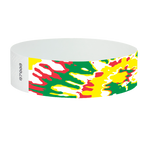


How Wristbands Help Security Teams Spot Unauthorized Guests Faster
At any event with more than a few hundred people, security teams face the same core challenge: identifying who belongs and who doesn't, quickly and accurately, without creating bottlenecks or confrontations. Paper tickets disappear into pockets. Hand stamps fade or smudge. Lanyards get tucked under jackets. When identification is hard to verify at a glance, unauthorized guests slip through gaps in the system, and the security team spends more time checking credentials than monitoring the crowd.
Wristbands solve this problem by turning admission into something visible, wearable, and verifiable from several feet away. Understanding how security teams use wristbands to manage access and catch unauthorized attendees reveals why wristbands have become the standard event guest identification method across festivals, concerts, and private events of every size.
Why Visual Identification Is the Foundation of Event Security
Effective event security depends on the ability to verify credentials without stopping every guest for a manual check. The faster a security team member can confirm that a guest belongs in a given area, the more time that team member has to watch for actual problems. Wristbands are built for exactly this kind of rapid visual verification.
The Problem With Tickets, Stamps, and Paper Passes
Traditional event guest identification methods all share the same weakness: they are difficult to verify quickly in a crowd. A paper ticket sits in a pocket or a bag, requiring the guest to stop, search, and present the document at every checkpoint. Hand stamps degrade with sweat, water, and friction. Lanyards and clip-on badges can be removed and handed to someone else between checkpoints. None of these methods gives security the ability to scan a crowd and assess credentials without direct interaction.
How Events Identify Authorized Guests With Wristbands
A wristband worn on the wrist is visible at all times, even in a dense crowd. Security personnel can scan a group of guests from a distance and immediately spot anyone not wearing the correct band. The wristband's color, pattern, or printed text communicates access level instantly, allowing security to focus attention on exceptions rather than routine verification. For events where spotting unauthorized guests at events is a priority, wristbands are the most practical tool available.
5 Ways Security Teams Use Wristbands to Spot Unauthorized Guests
The value of wristbands for event security goes well beyond basic admission control. A properly designed wristband program gives security teams multiple layers of visual and physical verification that work together to close gaps in access management. Here are the five most common security applications.
1. Instant Visual Verification From a Distance
The most fundamental advantage of wristbands is that they are always visible. A security team member stationed at a zone entrance or roaming through a crowd can verify wristband status from several feet away without approaching the guest. A quick glance at the wrist confirms the right color, the right pattern, and the right placement. Guests who are not wearing a band, or who are wearing the wrong color stand out immediately. For large events with thousands of attendees, this passive scanning capability is what makes wristband-based security practical at scale.
2. Color-Coding Access Levels Across Multiple Zones
Events with separate zones, such as general admission, VIP, backstage, and staff areas, rely on color-coded event wristbands to enforce who belongs where. Each access tier gets a unique wristband color, and every security checkpoint knows which colors are permitted in their area.
A typical color-coding structure for a multi-zone event might include:
- Green for general admission with access to the main floor and common areas
- Gold or black for VIP guests with access to premium seating, lounges, or meet-and-greet areas
- Red for backstage and artist areas, restricted to performers and production crew
- Blue for staff and vendors with access to operational zones not open to the public
When a guest wearing a green general admission band approaches a VIP entrance, the security team redirects them without needing to check a list, scan a barcode, or ask questions.
3. Daily Color Rotation to Prevent Reuse
Multi-day events and venues that operate on consecutive days use daily color rotation to prevent yesterday's wristband from being reused for free entry. Each day's admission band is a different color, and the previous day's color becomes invalid at closing. Security teams briefed on the current day's color can immediately identify anyone wearing an outdated band.
Custom Tyvek® wristbands are the most popular choice for daily rotation programs because of their low cost and wide color selection. Printing the date or a day-specific code on each band adds a second layer of verification that makes counterfeiting significantly harder.
4. Tamper-Evident Closures That Expose Transfer Attempts
One of the most common security breaches at events is wristband transfer, where a paying guest removes their band and passes it to someone who did not pay. Tamper-evident and tamper-proof closures are designed specifically to prevent this.
Tyvek® wristbands use adhesive closures that show visible tearing or wrinkling if removal is attempted, making it obvious to security that the band has been tampered with. Plastic wristbands and vinyl wristbands go a step further with one-time snap closures that lock permanently once applied. The only way to remove a snap-closure band is to cut it, which destroys the band and makes reuse impossible. For events where ticket fraud and unauthorized entry are a concern, snap closures give security teams confidence that every band on a wrist is the original issue.
5. Separating Age-Verified Guests From Underage Attendees
Events that serve alcohol face an additional identification challenge. Verifying age at every bar or service point slows down transactions and frustrates guests. Wristbands streamline this process by moving age verification to the entry gate, where staff check IDs once and issue a designated wristband color to guests who are of legal drinking age.
Bartenders and servers can then serve anyone wearing the verified color without re-checking identification at every transaction. Guests without the age-verified band are declined service instantly, with no ambiguity. Security teams monitoring the crowd can also spot underage guests attempting to approach alcohol service areas and intervene before a violation occurs.
Wristband Features That Make Security Checks Faster
Beyond color and closure type, several optional wristband features give security teams additional tools for faster and more accurate guest verification.
Bright Colors and Neon Options for Low-Light Venues
Concerts, nightclubs, evening festivals, and outdoor events that run after dark require wristband colors that remain visible under stage lighting, string lights, or flashlights. Neon and fluorescent colors are easier to spot in dim conditions than dark or muted tones. Glow-in-the-dark silicone bands provide an additional option for venues with extended low-light periods, though silicone bands are better suited for group identification than tamper-proof admission control.
Serial Numbering and Barcodes for High-Security Events
For events that need a higher level of credential verification, wristbands can be printed with unique serial numbers, barcodes, or QR codes that tie each band to a specific guest, ticket, or transaction record.
Features that support high-security operations include:
- Sequential serial numbering that allows managers to reconcile bands issued against total admissions sold
- Barcodes or QR codes that can be scanned at checkpoints for instant digital verification
- Duplicate numbering systems where both the guest and the event retain a matching number for cross-referencing
- Holographic printing on plastic wristbands that makes counterfeiting extremely difficult
These features are most commonly used at large concerts, multi-day festivals, and corporate events where unauthorized access carries significant financial or safety risk.
Give Your Security Team the Right Tools at the Gate
A strong wristband program makes every security checkpoint faster, every zone boundary clearer, and every unauthorized guest easier to spot. Wristband Express offers custom wristbands in Tyvek, plastic, vinyl, cloth, and silicone with color-coding, serial numbering, barcode printing, and tamper-proof closure options built for event security. Stock orders placed before 3 PM CST ship the same day. Start designing at wristbandexpress.com.
Frequently Asked Questions
1. What is the most secure wristband closure type for events?
Snap closures on plastic and vinyl wristbands are the most tamper-proof option. Once locked, the band cannot be removed without cutting, which prevents transfer between guests.
2. How do security teams verify wristbands in large crowds?
Security teams rely on visual scanning of wristband colors and patterns from a distance. Color-coding by access level allows staff to identify authorized and unauthorized guests without stopping each person individually.
3. Can wristbands prevent ticket fraud at events?
Yes. Tamper-evident adhesive closures on Tyvek bands and one-time snap closures on plastic and vinyl bands make it extremely difficult to remove, reuse, or counterfeit a wristband. Serial numbering and holographic printing add further anti-fraud layers.
4. How many wristband colors do I need for a multi-zone event?
Assign one color per access tier, plus a separate color for staff and vendors. Most multi-zone events use four to six colors to cover general admission, VIP, backstage, age-verified, and staff categories.
5. Do wristbands work for age verification at events serving alcohol?
Yes. Issuing a separate wristband color to guests who pass an ID check at the gate lets bartenders and servers verify age visually. Guests without the designated color are declined service without requiring a second ID check.
6. How does daily color rotation prevent unauthorized reuse?
Changing the admission wristband color every day means yesterday's band is no longer valid. Security teams briefed on the current day's color can immediately identify and flag anyone wearing an outdated band.
Share